Transformative agroecology in Burkina Faso


Project partners: Groundswell International & Association Nourrir Sans Détruire (ANSD)

Time frame: May 2024 – Nov 2025

Project lead: Vanja Westerberg

Background

The Burkinabè NGO Association Nourrir Sans Détruire (ANSD),  has promoted agroecology in Burkina Faso’s Eastern region since 2011, using a farmer-to-farmer model of innovation and knowledge sharing. Before ANSD’s interventions, agroecological practices were rare; today, adoption has become widespread – across some 100,000 hectares of farmland –  driven by organized community learning and experimentation. As highlighted by ANSD’s executive director, Ali Dianou  “Agroecology.” requires strengthening farmers’ organizations to test and spread technical and economic alternatives. Farmers co-creating knowledge allows communities to create a real pathway out of rural poverty, food insecurity, and environmental degradation

To analyse the impact of agroecology on farmer livelihoods, we interviewed and talked with more than 400 smallholders and crunched farm household data and remote sensing analysis. The results show a clear progression: as farmers adopt more agroecological practices, their incomes, yields and wellbeing improve. 

Agroecology’s Transformational Impact on Yields, Income, and Climate Resilience

Advanced agroecological farmers achieve significantly higher yields and income:
  • Yields were 77% higher for advanced agroecological farmers (1,230 kg/ha), nearly double that of farmers beginning their transition (695 kg/ha) during the 2023 growing season.
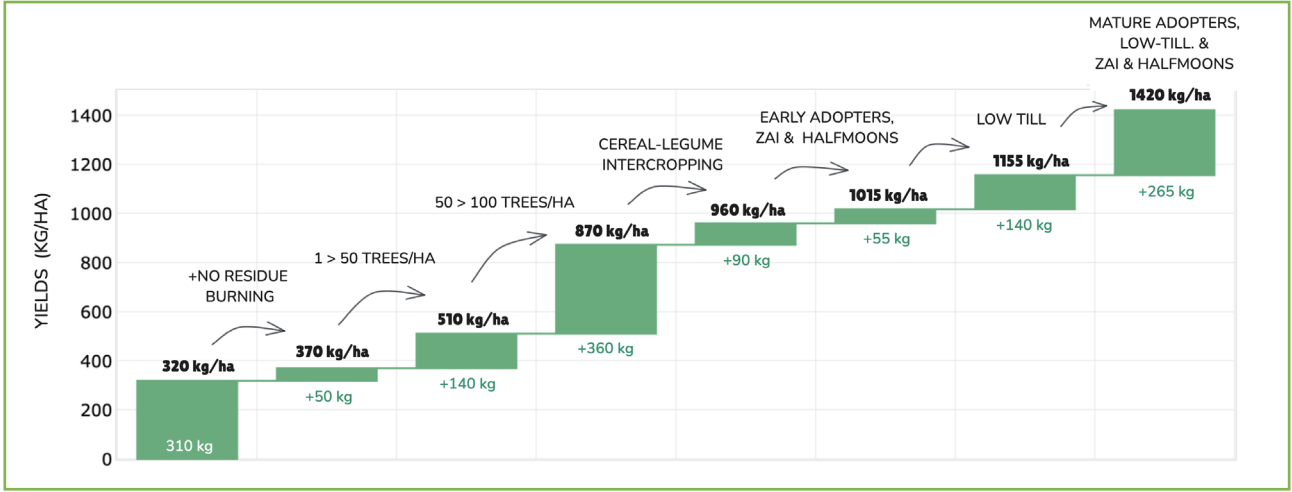
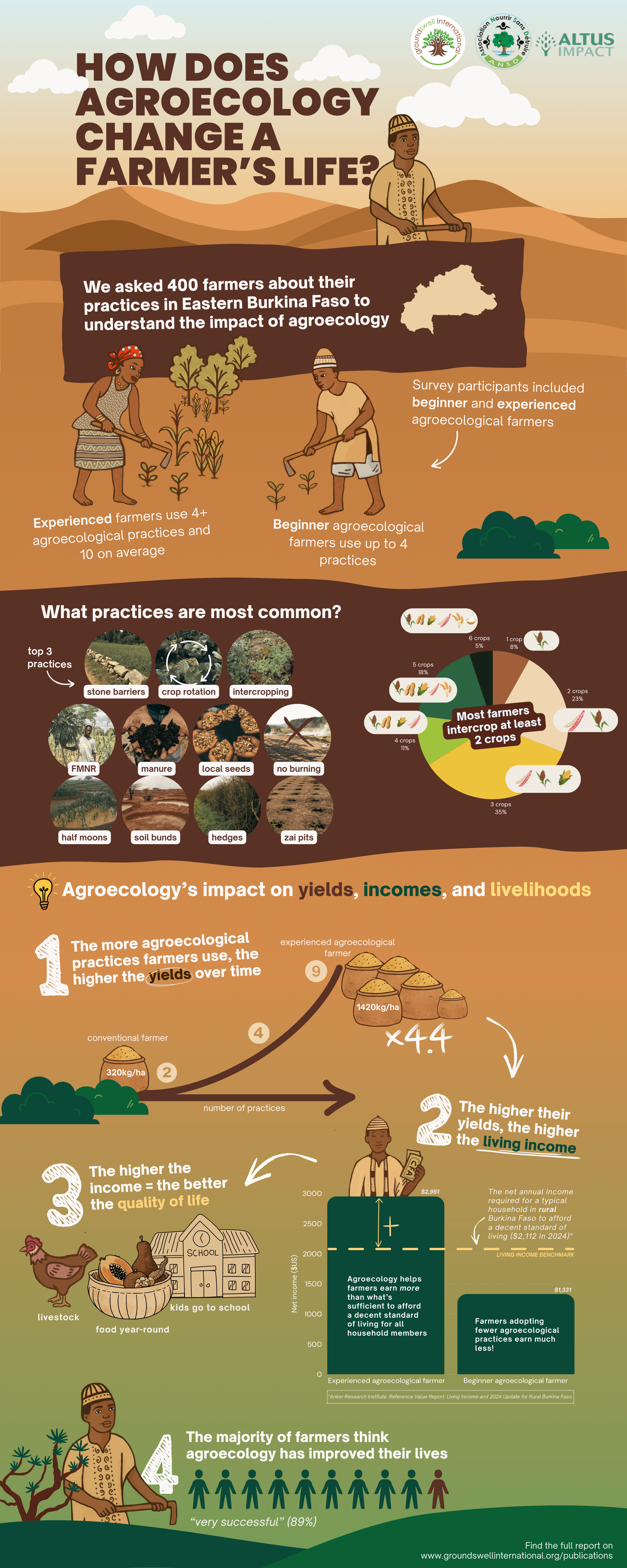
  • The most advanced agroecological systems had 4.4x higher yields (340% increase from 320 to 1,420 kg/ha) compared to farmers using no agroecological practices, demonstrating the full potential of agroecological transition.
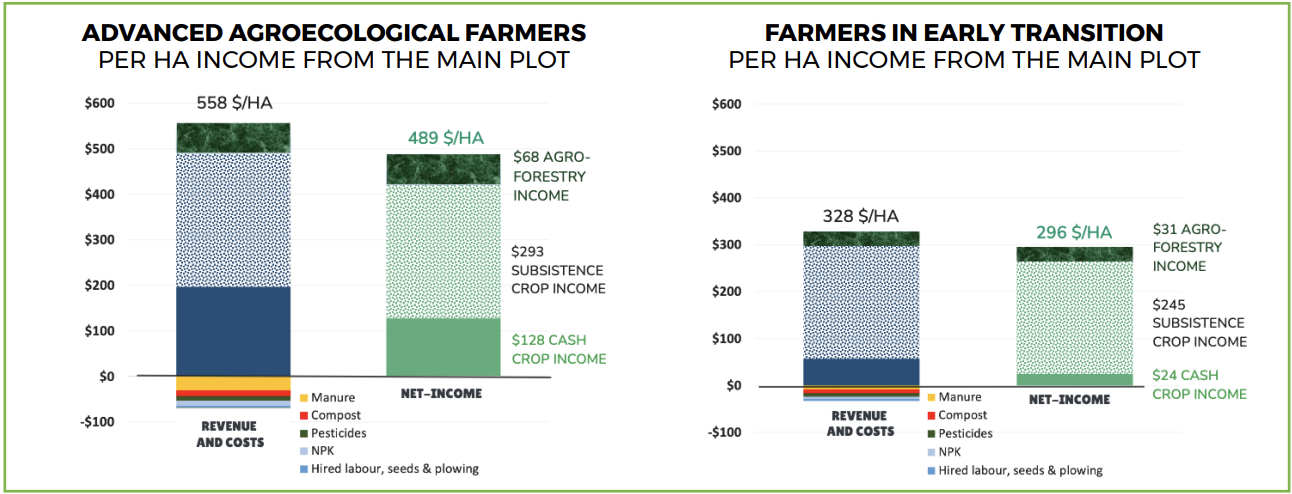
  • Net crop income per hectare was 67% higher for advanced agroecological farmers ($489/ha) compared to farmers in early transition phases to agroecology ($293/ha).
  • These results represent significant improvements in human wellbeing in a context where GDP per capita is only US$ 739 (in 2023).
Revenues, costs and net income for advanced agroecological and farmers in early transition

Agroecology builds resilience under climate stress

Farmers were interviewed in 2024, on the basis of their 2023 harvests. The 2023 growing season,  was extremely dry, with cumulative rainfall at just 300 mm, well below the 420 mm average (1981–2020).

  • Despite this, advanced agroecological farmers maintained robust yields. Satellite data reveal they have higher drought resilience, improved soil health, and increased land productivity, relative to farmers in early transition to agroecology.
  • The total food stock of advanced agroecological farmers at the time of the study was triple that of farmers in early transition.

Agroecology outperforms chemical input use

  • The study reveals that chemical fertilizers and pesticides provided no measurable yield increase in the study area and that herbicides had a slight positive impact on yields, but only at very low dosage levels. In contrast, agroecological practices consistently improved outcomes even under significant water stress.
  • The table below provides selected examples of how different practices and inorganic inputs impact yields.
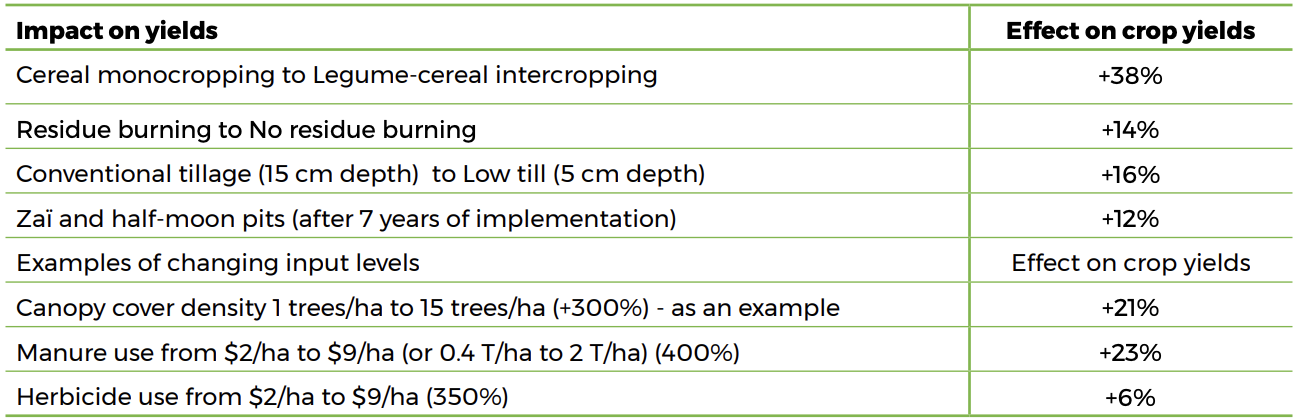
Table - Agroecological practices and inorganic inputs, and their impact on yields


This figure shows how the stacking of agroecological practices increases by an average of 340%.
Graphic of how yields increase as more agroecological practices are adopted
Illustration of how yields increase as more agroecological practices are adopted

Advanced agroecology helps farmers reach and surpass a Living Income

When analysing total household income, the analysis also demonstrated that advanced agroecological farmers earned 40% more than the Living Income benchmark of US$2,112  for rural Burkina Faso (Medinaceli et al., 2024) earning an average of $2,951 vs. $2,112, for early-transition farmers. It means that advanced agroecological farmers are able to afford a decent standard of living for all members of their household.
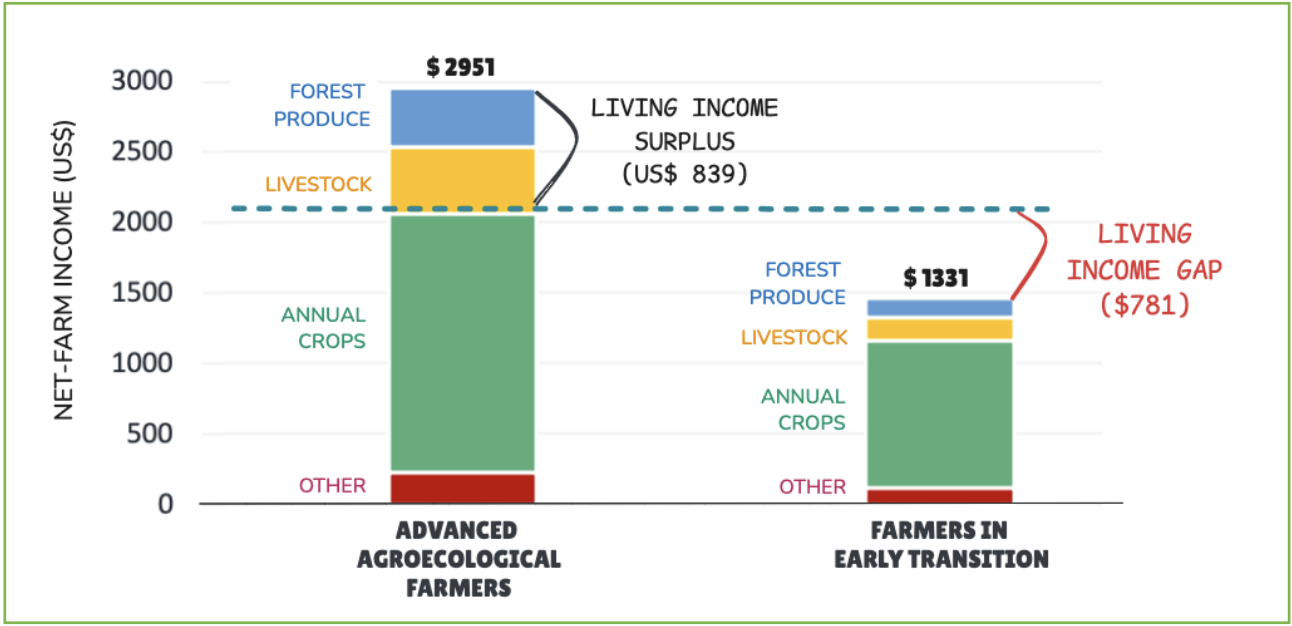
Total household income and living income surplus/gap for advanced agroecological farmers and
farmers in early transition
Total household income and living income surplus/gap for advanced agroecological farmers and
farmers in early transition
  • The investment case is equally strong. A popular combination of zaï pits, stone barriers, and FMNR generates an annualized effective return of 43% (the IRR), US$4.8 in revenues per US$1 invested, and an NPV of US$2,308 over 15 years. The main barrier to adoption is a 5.4-year payback period, which far exceeds typical loan durations of six months to two years. Patient capital or targeted NGO and policy support can close this gap. For example, under an earlier government programme (PNTG2), stone barriers were subsidised, reducing the pay-off period to 4.5 years and increasing the IRR to 64%.
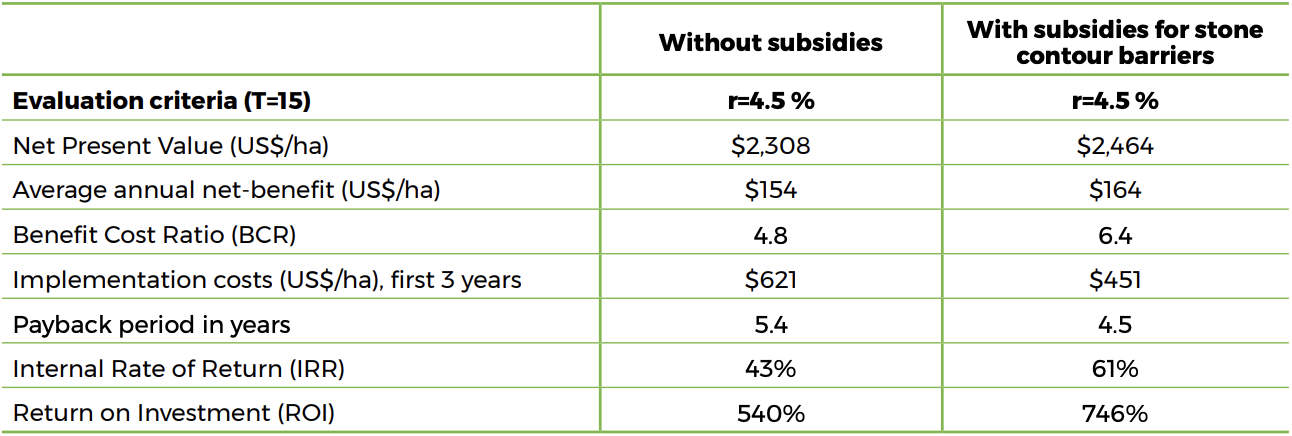
Cost-Benefit Analysis results per ha farmland when transitioning to advanced agroecology, an example of a zaï
pits, stone barriers and FMNR in combination (15 year time horizon and discount rate of 4.5% representing Burkina Faso's average real interest-rate for the previous 10 years)
Cost-Benefit Analysis results per hectare farmland, when transitioning to advanced agroecology,
example of a ‘Zai pits, stone barrier and FMNR’ package (discount rate of 4.5%, 15 years time horizon)

Impact
The evidence is unambiguous: agroecology improves resilience and delivers high-impact, bankable development returns (Westerberg & Dianou, 2025).  Farmer-led agroecology belongs at the heart of national strategies for land restoration, food security, and peacebuilding — and squarely within the ambition of Burkina Faso’s NDCs and the Sustainable Development Goals.

ANSD are now urging the government agencies at all levels, donors, and investors to scale agroecology. Key recommendations include:

  1. Repurposing agricultural subsidies currently directed at chemical inputs toward agroecological investments with proven returns.
  2. Supporting blended finance models such as grants, credit guarantees, and concessional loans to help farmers overcome upfront transition costs.
  3. Using (1) and (2) to invest in appropriate tools and equipment to reduce labor barriers and make agroecology more accessible, while supporting local rural enterprises needed for agroecology (seed banks, biological inputs, saving and credit groups, etc.).
  4. Integrating agroecology into national strategies for land restoration, food security, peace building, and climate resilience, aligning with Burkina Faso’s NDCs and Sustainable Development Goals.

Download available resources

Simplified Infographic Download
Full Impact Study Download
Transformational Agroecology in Burkina Faso - Policy Brief
Policy Brief Download

Study presentation (EN)

Study presentation (FR)